
The Strange Familiarity of Emotional Pain
Few experiences are as confusing as realizing that, despite different faces, names, and stories, our relationships seem to follow the same emotional script. The partners change, the circumstances vary, but the pain feels eerily familiar. Again and again, we find ourselves loving too much, giving too much, tolerating too much, and receiving too little.
This repetition is not accidental. It is structured.
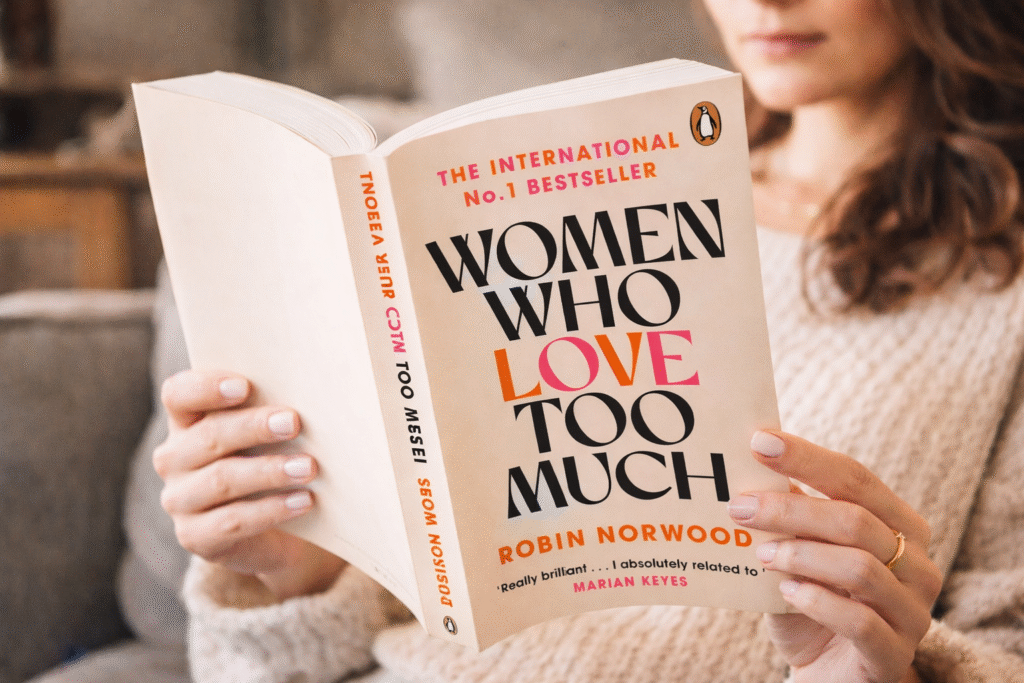
Robin Norwood’s Women Who Love Too Much offers one of the clearest explanations for why so many people remain trapped in recurring relational dynamics. According to Norwood, what we often interpret as “love” is, in reality, a compulsive attempt to resolve unresolved emotional wounds from the past.
Emotional Conditioning and the Roots of Repetition
At the heart of repeated relationship patterns lies emotional conditioning. Human beings do not enter relationships neutrally. We carry an internal map of what intimacy feels like, formed primarily during childhood.
When love early in life was inconsistent, conditional, or paired with emotional chaos, the nervous system adapts. Stability becomes unfamiliar. Emotional unpredictability becomes recognizable. As adults, we unconsciously seek what feels known, not what is healthy.
Norwood explains that many people who love too much were raised in environments where their emotional needs were secondary. One or both caregivers may have been emotionally unavailable due to addiction, mental illness, emotional immaturity, or their own unresolved trauma. The child learns to survive by becoming hyper-aware of others’ needs, suppressing her own emotional reality in the process.
When Love Becomes a Role, Not a Relationship
This early adaptation does not disappear in adulthood. It evolves into a relational role.
Instead of asking “How do I feel with this person?”, the focus becomes “How can I help, fix, or save them?”. Relationships become projects. Emotional exhaustion becomes proof of commitment. Suffering becomes normalized.
Norwood emphasizes that this is not self-sacrifice born of generosity, but a compulsive pattern rooted in fear: the fear that without constant effort, love will disappear.
Attachment Theory and Emotional Unavailability
Modern attachment theory helps clarify why these dynamics repeat so reliably. Individuals with anxious attachment styles tend to be drawn to emotionally avoidant partners. This pairing recreates a familiar emotional imbalance: one person pursues closeness while the other withdraws.
For the anxiously attached individual, love feels like vigilance, effort, and emotional labor. When paired with someone emotionally distant, the nervous system recognizes the pattern instantly. The unconscious belief resurfaces: if I try harder, maybe this time I will be chosen.
The Neuroscience of Intermittent Love
Norwood’s work becomes even more compelling when examined through the lens of neuroscience.
The brain’s reward system is particularly sensitive to intermittent reinforcement. Love that appears unpredictably — sometimes present, sometimes withdrawn — triggers stronger dopamine responses than consistent affection. This mechanism mirrors the same neurological patterns observed in addiction.
This is why emotionally unavailable partners can feel so intoxicating. The highs feel euphoric precisely because the lows are so painful. The nervous system becomes addicted not to the person, but to the emotional cycle.
Why Insight Alone Is Not Enough
One of the most frustrating aspects of repeated relationship patterns is that awareness does not automatically lead to change. Many people understand intellectually that their relationships are unhealthy, yet feel unable to leave or choose differently.
This is because the pattern is not purely cognitive. It is embodied. It lives in emotional memory, in the nervous system, and in identity itself. Letting go of the pattern often feels like losing a part of oneself.
To abandon familiar relational dynamics can trigger deep anxiety, emptiness, or even grief. Stability may feel foreign. Calm may feel meaningless. Healthy love can initially register as emotional absence.
Self-Worth and the Moralization of Suffering
A central theme in Women Who Love Too Much is the role of self-worth.
Many individuals trapped in these patterns carry an unconscious belief that they are not inherently worthy of love. Relationships become arenas where worth must be proven through endurance, sacrifice, and emotional overextension. Pain becomes evidence of devotion.
Culture reinforces this distortion. Romantic narratives often glorify struggle, intensity, and emotional suffering. Love is framed as something that must be fought for, even at the cost of one’s well-being.
Norwood challenges this narrative directly. She argues that healthy love is not dramatic or consuming. It is stable, reciprocal, and emotionally safe — qualities that often feel unfamiliar to those conditioned by early emotional neglect.
Repetition Compulsion and Unfinished Emotional Narratives
Freud referred to this phenomenon as repetition compulsion: the unconscious drive to reenact unresolved emotional experiences in an attempt to gain mastery over them.
Modern trauma research supports this idea. When emotional wounds are not processed, the psyche seeks familiar situations in which the original pain might finally be resolved. The tragedy is that without awareness and intervention, the same outcome is usually reproduced.
We repeat not because we fail to learn, but because something inside us is still trying to be healed.
Healing the Pattern, Not Just the Relationship
Norwood frames recovery not as the suppression of desire, but as a reorientation of love toward the self. Healing begins when individuals stop abandoning themselves in the name of connection.
This process involves developing emotional boundaries, learning to tolerate stability, and redefining love as something that does not require self-erasure. It also requires grief — for past relationships, for unmet childhood needs, and for the fantasy that love can be earned through suffering.
Change is not instant. But it is possible.
Redefining Love Beyond Familiar Pain
The reason we repeat the same relationship patterns is not weakness, irrationality, or lack of intelligence. It is loyalty — loyalty to emotional strategies that once ensured survival.
Women Who Love Too Much remains relevant decades after its publication because it names this truth with precision and compassion. Patterns can be unlearned, but only when love is no longer confused with pain.
Real love does not require self-destruction. It requires presence, reciprocity, and the courage to choose the unfamiliar over the familiar.
References and Influences
Norwood, R. Women Who Love Too Much.
Bowlby, J. Attachment and Loss.
Ainsworth, M. et al. Patterns of Attachment.
Freud, S. Beyond the Pleasure Principle.
Van der Kolk, B. The Body Keeps the Score.
Levine, A. & Heller, R. Attached.
- ¿Se puede ganar dinero realmente con los juegos en línea?
- Cómo la dopamina hace que la gente siga desplazándose por la pantalla
- ¿Por qué seguimos repitiendo los mismos patrones en nuestras relaciones?
- La psicología detrás de nuestra obsesión por las recompensas virtuales
- Cómo los adolescentes ganan dinero en línea de forma legal