
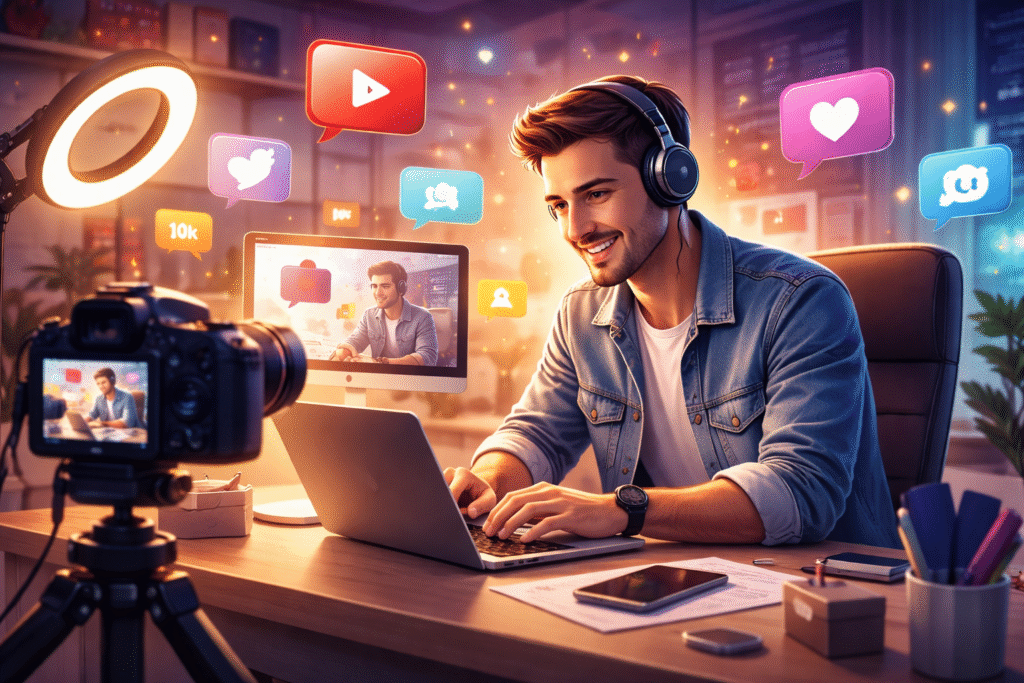
The role of content creators has changed dramatically over the past decade, but the transformation we are witnessing now goes far beyond platforms, algorithms, or trends. In 2026, being a content creator is no longer about chasing virality or posting daily to stay relevant. It is about building systems, authority, and sustainable attention in an increasingly saturated digital world.
What once started as a side hobby has evolved into a serious digital profession. Content creators today operate as micro media companies, combining creativity, strategy, technology, and business thinking. And as we move deeper into 2026, this shift becomes even more evident.
The future of content creation is not defined by who posts more, but by who understands the ecosystem better.
From creators to digital operators
In 2026, successful content creators are no longer just writers, video producers, or influencers. They are operators of digital ecosystems. Instead of relying on a single platform, they distribute their content across websites, newsletters, social media, podcasts, and private communities.
This decentralization is not accidental. Platforms change rules constantly, algorithms fluctuate, and reach is never guaranteed. Creators who depend entirely on one channel are increasingly vulnerable. As a result, many are investing in owned platforms, especially websites and email lists, where they control distribution and monetization.
Websites are no longer static portfolios. They are living hubs that aggregate content, capture traffic from search engines, and convert readers into long-term audiences. In this new model, creators stop renting attention and start owning it.
Artificial intelligence as a creative partner
Artificial intelligence has become one of the most debated topics in the creator economy. By 2026, AI tools are deeply integrated into the content creation process, but not in the way many feared.
Rather than replacing creators, AI has become a creative partner. It accelerates research, helps structure ideas, assists with editing, and automates repetitive tasks. This allows creators to focus on what truly matters: perspective, storytelling, and interpretation.
The creators who thrive are not those who resist AI, but those who learn how to use it strategically. AI does not create meaning on its own. It amplifies human intent. In a world flooded with generated content, originality, taste, and editorial judgment become even more valuable.
Ironically, the rise of AI has increased the demand for human voice.
Authenticity as a competitive advantage
As content becomes easier to produce, authenticity becomes harder to fake. In 2026, audiences are more sensitive to generic, shallow, or overly optimized content. They recognize patterns, formulas, and artificial tones almost instantly.
This creates a paradox. While technology allows anyone to publish, only those with a clear point of view stand out.
The future of content creators favors those who develop a recognizable voice, consistent themes, and intellectual honesty. Audiences are not looking for perfection. They are looking for coherence. They want to follow creators who think deeply, question assumptions, and are willing to explore complexity rather than simplify everything into quick answers.
Trust, once lost, is almost impossible to recover.
Monetization beyond ads and sponsorships
Monetization models have also matured significantly. While advertising and brand deals still exist, they are no longer the primary source of income for many creators.
In 2026, creators monetize through digital products, memberships, educational content, consulting, licensing, and niche communities. Instead of chasing massive audiences, many focus on smaller but highly engaged groups.
This shift allows creators to align revenue with value. When monetization is built around expertise rather than reach, creators gain more stability and independence. They can say no to partnerships that do not align with their values and focus on long-term growth instead of short-term metrics.
Content becomes an entry point, not the final product.
Search engines and long-form content regain importance
Despite the dominance of short-form videos and fast consumption, long-form content has regained relevance in 2026, especially through search engines. People still search for answers, explanations, and context. And when they do, they prefer depth over speed.
Creators who invest in well-structured articles, thoughtful essays, and evergreen content benefit from consistent organic traffic. Unlike social media posts, which disappear in hours, search-based content compounds over time.
This is why many creators are returning to blogging, not as a nostalgic practice, but as a strategic decision. A single high-quality article can attract readers for years, creating a stable foundation for audience growth.
In this sense, content creation becomes closer to publishing than posting.
The rise of niche creators
Mass appeal is no longer the main goal. The future belongs to niche creators who understand their audience deeply. Whether the topic is productivity, relationships, technology, or culture, specificity wins.
Niche creators build stronger connections, face less competition, and monetize more effectively. Their content feels personal, relevant, and intentional. Instead of trying to please everyone, they focus on serving a defined group with clarity and consistency.
This focus also reduces burnout. When creators stop chasing trends and start building within their domain, content creation becomes more sustainable and intellectually rewarding.
A more professional creator mindset
Perhaps the biggest shift in 2026 is mental. Content creators no longer see themselves as casual participants in the digital space. They think like professionals.
They plan content strategically, analyze performance critically, invest in learning, and understand the basics of SEO, analytics, and audience behavior. Creativity remains essential, but it is supported by structure and discipline.
This does not mean creativity becomes mechanical. On the contrary. Structure frees creativity by removing chaos.
The creators who succeed in the future are those who treat content creation as both an art and a system.
What the future really demands
The future of content creators in 2026 does not belong to those who publish the most, shout the loudest, or follow every trend. It belongs to those who think clearly, communicate honestly, and build patiently.
Technology will continue to evolve. Platforms will rise and fall. Tools will become faster and more powerful. But the core of content creation remains unchanged: humans seeking meaning, understanding, and connection.
Creators who understand this will not only survive the future. They will define it.
- ¿Se puede ganar dinero realmente con los juegos en línea?
- Cómo la dopamina hace que la gente siga desplazándose por la pantalla
- ¿Por qué seguimos repitiendo los mismos patrones en nuestras relaciones?
- La psicología detrás de nuestra obsesión por las recompensas virtuales
- Cómo los adolescentes ganan dinero en línea de forma legal