
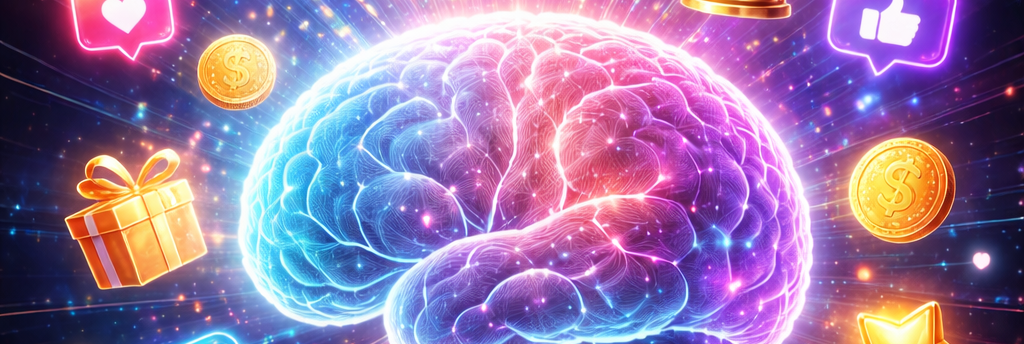
Understanding why humans love virtual rewards requires going beyond surface-level explanations. It is not simply about entertainment or habit. It is about how the human brain evolved to seek meaning, recognition, progress, and belonging — and how digital systems learned to replicate those signals with astonishing precision.
The evolutionary roots of reward-seeking behavior
Long before screens, apps, or games existed, human survival depended on reward-based learning. The brain evolved to associate certain actions with positive outcomes: food after hunting, safety after cooperation, status after contribution to the group.
Neuroscientific research shows that dopamine — often misunderstood as a “pleasure chemical” — is primarily a motivation and anticipation signal, not pleasure itself. Dopamine spikes when the brain predicts a reward, pushing us to repeat behaviors that previously led to positive outcomes.
Digital environments did not invent this mechanism. They optimized it.
According to neuroscientist Wolfram Schultz, dopamine neurons respond more strongly to unexpected rewards than predictable ones, a principle that modern digital platforms actively exploit.
Source:
Schultz, W. (1998). Predictive reward signal of dopamine neurons. Journal of Neurophysiology.
Why virtual rewards feel meaningful despite being intangible
A common assumption is that virtual rewards should feel empty because they lack physical value. In practice, the opposite often happens.
Virtual rewards work because the brain does not evaluate rewards based on physical substance, but on symbolic meaning and contextual value.
A digital badge represents:
- Progress
- Recognition
- Mastery
- Belonging to a group
Psychologist Mihaly Csikszentmihalyi’s concept of flow helps explain this. Flow occurs when people experience deep engagement in tasks that offer clear goals, immediate feedback, and a sense of progression — exactly the structure behind most virtual reward systems.
Source:
Csikszentmihalyi, M. (1990). Flow: The Psychology of Optimal Experience.
The role of social validation and status
Humans are social animals. Much of our motivation is driven not by absolute rewards, but by relative position within a group.
Virtual rewards often act as status markers:
- Levels
- Ranks
- Verified badges
- Follower counts
- Exclusive access
Research in social psychology shows that status recognition activates the same neural pathways as material rewards. In some cases, social approval triggers even stronger responses than financial incentives.
This explains why people care deeply about:
- Likes and comments
- Leaderboards
- Rare in-game items
- Limited-time achievements
These signals communicate value within a social hierarchy — even if that hierarchy exists purely online.
Source:
Anderson, C., Hildreth, J. A. D., & Howland, L. (2015). Is the desire for status a fundamental human motive? Psychological Bulletin.
Variable rewards and the psychology of anticipation
One of the most powerful mechanisms behind virtual rewards is variable reinforcement, a concept introduced by behavioral psychologist B.F. Skinner.
When rewards are unpredictable — appearing at irregular intervals — engagement increases dramatically. This is the same principle behind slot machines, but it is also present in:
- Loot boxes
- Random drops
- Algorithmic feeds
- Surprise notifications
The anticipation becomes more motivating than the reward itself. Each interaction carries the possibility of something meaningful happening, which keeps attention locked in.
Modern platforms carefully balance predictability and surprise to maximize engagement without causing immediate burnout.
Source:
Skinner, B. F. (1953). Science and Human Behavior.
Virtual rewards as identity reinforcement
Beyond motivation, virtual rewards increasingly serve as tools for identity construction.
People use digital achievements to answer questions like:
- Who am I good at being?
- What do I belong to?
- How do others see me?
In games, productivity apps, and social platforms, rewards reinforce a narrative of self:
- “I am disciplined” (streaks)
- “I am skilled” (levels)
- “I am recognized” (badges)
- “I am consistent” (daily progress markers)
Sociologist Erving Goffman argued that identity is largely performed in social contexts. Digital environments simply provided a new stage — with rewards acting as symbolic costumes.
Source:
Goffman, E. (1959). The Presentation of Self in Everyday Life.
The emotional comfort of measurable progress
In an uncertain world, virtual rewards offer something rare: clear feedback.
Real life progress is often slow, ambiguous, and invisible. Digital systems, however, make progress visible:
- Bars filling up
- Numbers increasing
- Goals marked as completed
This creates a sense of control and reassurance. Even small virtual wins can stabilize emotions, reduce anxiety, and create momentum — especially during periods of uncertainty or stress.
This is one reason productivity apps, fitness trackers, and gamified learning tools gained massive popularity in recent years.
When virtual rewards become problematic
While virtual rewards can motivate and empower, they can also distort priorities.
Problems arise when:
- Rewards replace intrinsic motivation
- Validation becomes addictive
- Progress is measured only digitally
- Identity becomes dependent on external metrics
Researchers warn that overreliance on extrinsic rewards can weaken long-term satisfaction if not balanced with meaning and autonomy.
Source:
Deci, E. L., & Ryan, R. M. (2000). Intrinsic and Extrinsic Motivations. Contemporary Educational Psychology.
Conclusion
Humans love virtual rewards because they speak directly to ancient psychological systems: motivation, status, identity, and meaning. Digital environments did not create these desires — they refined them, amplified them, and made them measurable.
Understanding why humans love virtual rewards is essential not only for designers and creators, but for anyone navigating modern digital life. The challenge ahead is not eliminating virtual rewards, but learning how to use them consciously — as tools for growth rather than substitutes for purpose.
Virtual rewards have become one of the most powerful forces shaping human behavior in the digital age. From game achievements and social media likes to digital badges, streaks, and in-app currencies, people willingly invest time, attention, and even money into rewards that have no physical existence. Yet their impact is real — emotionally, psychologically, and economically.
Understanding why humans love virtual rewards requires going beyond surface-level explanations. It is not simply about entertainment or habit. It is about how the human brain evolved to seek meaning, recognition, progress, and belonging — and how digital systems learned to replicate those signals with astonishing precision.
The evolutionary roots of reward-seeking behavior
Long before screens, apps, or games existed, human survival depended on reward-based learning. The brain evolved to associate certain actions with positive outcomes: food after hunting, safety after cooperation, status after contribution to the group.
Neuroscientific research shows that dopamine — often misunderstood as a “pleasure chemical” — is primarily a motivation and anticipation signal, not pleasure itself. Dopamine spikes when the brain predicts a reward, pushing us to repeat behaviors that previously led to positive outcomes.
Digital environments did not invent this mechanism. They optimized it.
According to neuroscientist Wolfram Schultz, dopamine neurons respond more strongly to unexpected rewards than predictable ones, a principle that modern digital platforms actively exploit.
Source:
Schultz, W. (1998). Predictive reward signal of dopamine neurons. Journal of Neurophysiology.
Why virtual rewards feel meaningful despite being intangible
A common assumption is that virtual rewards should feel empty because they lack physical value. In practice, the opposite often happens.
Virtual rewards work because the brain does not evaluate rewards based on physical substance, but on symbolic meaning and contextual value.
A digital badge represents:
- Progress
- Recognition
- Mastery
- Belonging to a group
Psychologist Mihaly Csikszentmihalyi’s concept of flow helps explain this. Flow occurs when people experience deep engagement in tasks that offer clear goals, immediate feedback, and a sense of progression — exactly the structure behind most virtual reward systems.
Source:
Csikszentmihalyi, M. (1990). Flow: The Psychology of Optimal Experience.
The role of social validation and status
Humans are social animals. Much of our motivation is driven not by absolute rewards, but by relative position within a group.
Virtual rewards often act as status markers:
- Levels
- Ranks
- Verified badges
- Follower counts
- Exclusive access
Research in social psychology shows that status recognition activates the same neural pathways as material rewards. In some cases, social approval triggers even stronger responses than financial incentives.
This explains why people care deeply about:
- Likes and comments
- Leaderboards
- Rare in-game items
- Limited-time achievements
These signals communicate value within a social hierarchy — even if that hierarchy exists purely online.
Source:
Anderson, C., Hildreth, J. A. D., & Howland, L. (2015). Is the desire for status a fundamental human motive? Psychological Bulletin.
Variable rewards and the psychology of anticipation
One of the most powerful mechanisms behind virtual rewards is variable reinforcement, a concept introduced by behavioral psychologist B.F. Skinner.
When rewards are unpredictable — appearing at irregular intervals — engagement increases dramatically. This is the same principle behind slot machines, but it is also present in:
- Loot boxes
- Random drops
- Algorithmic feeds
- Surprise notifications
The anticipation becomes more motivating than the reward itself. Each interaction carries the possibility of something meaningful happening, which keeps attention locked in.
Modern platforms carefully balance predictability and surprise to maximize engagement without causing immediate burnout.
Source:
Skinner, B. F. (1953). Science and Human Behavior.
Virtual rewards as identity reinforcement
Beyond motivation, virtual rewards increasingly serve as tools for identity construction.
People use digital achievements to answer questions like:
- Who am I good at being?
- What do I belong to?
- How do others see me?
In games, productivity apps, and social platforms, rewards reinforce a narrative of self:
- “I am disciplined” (streaks)
- “I am skilled” (levels)
- “I am recognized” (badges)
- “I am consistent” (daily progress markers)
Sociologist Erving Goffman argued that identity is largely performed in social contexts. Digital environments simply provided a new stage — with rewards acting as symbolic costumes.
Source:
Goffman, E. (1959). The Presentation of Self in Everyday Life.
The emotional comfort of measurable progress
In an uncertain world, virtual rewards offer something rare: clear feedback.
Real life progress is often slow, ambiguous, and invisible. Digital systems, however, make progress visible:
- Bars filling up
- Numbers increasing
- Goals marked as completed
This creates a sense of control and reassurance. Even small virtual wins can stabilize emotions, reduce anxiety, and create momentum — especially during periods of uncertainty or stress.
This is one reason productivity apps, fitness trackers, and gamified learning tools gained massive popularity in recent years.
When virtual rewards become problematic
While virtual rewards can motivate and empower, they can also distort priorities.
Problems arise when:
- Rewards replace intrinsic motivation
- Validation becomes addictive
- Progress is measured only digitally
- Identity becomes dependent on external metrics
Researchers warn that overreliance on extrinsic rewards can weaken long-term satisfaction if not balanced with meaning and autonomy.
Source:
Deci, E. L., & Ryan, R. M. (2000). Intrinsic and Extrinsic Motivations. Contemporary Educational Psychology.
Humans love virtual rewards because they speak directly to ancient psychological systems: motivation, status, identity, and meaning. Digital environments did not create these desires — they refined them, amplified them, and made them measurable.
Understanding why humans love virtual rewards is essential not only for designers and creators, but for anyone navigating modern digital life. The challenge ahead is not eliminating virtual rewards, but learning how to use them consciously — as tools for growth rather than substitutes for purpose.
- ¿Se puede ganar dinero realmente con los juegos en línea?
- Cómo la dopamina hace que la gente siga desplazándose por la pantalla
- ¿Por qué seguimos repitiendo los mismos patrones en nuestras relaciones?
- La psicología detrás de nuestra obsesión por las recompensas virtuales
- Cómo los adolescentes ganan dinero en línea de forma legal